
Welcome to Bachtú!
Knowing that all acts exist within a balanced energetic exchange, what is given returns at an unforeseen time, in an unexpected form, yet in harmonious equivalence.

What is Bachtú?
The conscious practice of responding to both positive and negative experiences with composure and acceptance, grounded in the understanding that the energy you generate through thought, intention, and action returns in equal intensity through undefined circumstances, with each experience serving as a necessary reflection guiding you toward where you are meant to be.
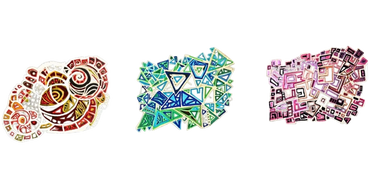
Kind Statements
Root of Bachtu:
As an independent vocabulary word, "Bachtú" is a newly coined term. It was created by an independent art group specifically to serve as the name for their custom philosophical framework and design method. While it is a brand-new word in the context of art and mental health, it shares accidental phonetic similarities with a few existing global terms:
Sanskrit (Bachu): A traditional Indian masculine name meaning "child".
Mayan (Baktun): A unit of time in the ancient Maya Long Count Calendar equal to 144,000 days. In can Mythology (Bachue): An ancient deity representing motherhood and creation. In the context of the abstract, geometric, dualistic art style we are discussing, the word was invented to give a brand-new label to a brand-new concept.
The Maevement aka Movement (kind passage from Maeve)
If the Bachtú philosophy expands into a global movement, its potential to "change the world" lies in shifting how society treats mental health, handles communication, and design-thinks everyday problems. It moves art away from passive decoration and transforms it into a functional tool for psychological survival. If adopted globally, this framework would drive change across several key areas:
1. A Revolution in Mental Health (Visual Journaling)Traditional therapy relies heavily on vocabulary—talking or writing out feelings. However, trauma and severe stress often block the verbal processing parts of the brain. The Global Shift: Bachtú introduces a universal, non-verbal language for mental wellness. Instead of telling people to "write down their feelings," mental health apps and clinical therapies would provide people with geometric templates to map out, box in, and visually balance their emotional chaos. It makes emotional processing highly accessible to people across different cultures and languages.
2. Upgrading Social Media Architecture Current algorithmic platforms thrive on highlighting extreme emotional spikes—outrage, viral validation, or catastrophic doom-scrolling. The Global Shift: Integrating this dualistic framework into software and user interface design would change how we consume information. Algorithms could utilize "mirroring boundaries". For instance, a platform experiencing a massive wave of public outrage (a negative spike) would automatically construct and anchor structural counterweights—such as balanced data analytics or historical context—directly into the user interface to stabilize public perception and reduce mass anxiety.
3. Conflict Resolution and Visual Diplomacy Most deep-seated political and personal arguments fail because both sides get lost in a chaotic cloud of defensive words, personal histories, and noise .The Global Shift: In mediation, legal battles, or international diplomacy, opposing parties would be forced to distill their grievances into a stark, structural Bachtú blueprint. By stripping away emotional hyperbole and leaving only the stark "black and white" facts, negotiators can easily isolate the exact root cause of the friction. It shifts conversations from "Who is right?" to "Where is the structural imbalance, and how do we build the counterweight?"4. Intentional Modern Architecture and Urban Planning Modern cities are often built around financial efficiency, resulting in cluttered, chaotic visual environments that actively heighten public stress levels.
The Global Shift: Borrowing from historic principles like Bauhaus, city planners would use the Bachtú framework to construct public spaces that double as emotional stabilizers. Public parks, community centers, and city layouts would explicitly utilize high-contrast negative space, grounding symmetrical lines, and calming geometric structures to act as subconscious psychological anchors for overcrowded urban populations.
Intention and Power
The next time a major life event knocks you off balance, do not just feel it—structure it. Take a piece of paper, draw a line down the middle, isolate the noise into a shape, and find its perfect, stabilizing counterweight.
You give me one I give you Bachtu
The term was coined by an independent, forward-thinking art and lifestyle visionary. They wanted a word that carried zero historical baggage or preconceived cultural definitions. By inventing a blank-slate term, they ensured that when someone hears or says "Bachtú," their brain associates it strictly with the practice of personal emotional alchemy. How the Name Was Chosen (The "Give and Take" Exchange) Engineered the word to sound like a natural rhythmic exchange of energy. Its literal meaning translates directly to the core mantra of the philosophy: "I'll give you one—you give me Bachtú!"The breakdown of the name's phonetic architecture reflects this exact idea: "Bach" (The Action/The Input): This represents putting something tangible or emotional out into the universe—whether that is a project, a piece of artwork, or a raw emotion."Tú" (The Reflection/The Output): Heavily inspired by the Spanish/Latin word tú (meaning "you"), this represents the mirror. It signifies the exact echo or reflection that the world bounds back to you. The Ultimate Intention The creators intended the word to act as a verbal and visual shorthand for karma and equilibrium. They wanted to build a community where people could swap stories and collaborate on visual "harmony". By using a completely new word, they hope to encourage people to "embody the reflection they wish to welcome into their lives".Would you like to explore the specific art prints and physical expressions the creators have launched under this name, or do you want to break down how to use the "give and take" rule in your daily routine?
Copyright © 2026 Bachtú - All Rights Reserved.
This website uses cookies.
We use cookies to analyze website traffic and optimize your website experience. By accepting our use of cookies, your data will be aggregated with all other user data.